

Moving Picture (946-3) Reich/Richter
Steve Reich and Gerhard Richter- two legends of contemporary music and visual art meet and create a new experience of time, sound, and image emerges, in the year that Steve Reich is celebrating his 90th birthday.
A Japan premier of an extraordinary collaboration between two artists whose influence extends far beyond their own disciplines into jazz, electronic music, dance, literature, and contemporary culture.Performed by Ensemble Nomad, the evening also features the emerging young Korean composer Lee Hanurij, and Takemitsu Toru, whose legacy is closely associated with Sogetsu Art Center in the 1960s.
Program
 Moving Picture (946-3)
Film by Gerhard Richter & Corinna Belz
Music: Steve Reich
Montage: Rudi Heinen
© Gerhard Richter and Corinna Belz
Curated by Hans Ulrich Obrist and Alex Poots
Reich/Richter is a joint film-and-music work by composer Steve Reich and visual artist Gerhard Richter, developed with filmmaker Corinna Belz. The visual component of Moving Picture (946-3) belongs to a technique Richter and Belz developed for breaking a single painting down photographically, then dividing, mirroring and reassembling the fragments into an evolving abstract sequence — closely mirroring, structurally, Reich's own process-based, phasing approach to music. Sound and image move independently but share a logic of repetition and gradual transformation.
The collaboration grew out of a 2009 encounter, when Reich performed Drumming Part 1 inside a Richter exhibition at the Ludwig Museum in Cologne and Music for 18 Musicians at the nearby Philharmonie — an experience that led the two artists to plan a joint project. The piece premiered at The Shed in New York in April 2019, commissioned jointly by The Shed, the LA Philharmonic under Gustavo Dudamel, Cal Performances, the Barbican/Britten Sinfonia, the Philharmonie de Paris, and the Oslo Philharmonic. At the premiere, Ensemble Signal performed Reich's score live in front of Belz's film, itself built from Richter's 2016 squeegee painting Abstraktes Bild (CR 946-3).
Information
- Performance Title
- No Centre 1
Moving Picture (946-3) Reich/Richter - Performers
- Ensemble NOMAD
- Performance Dates and Times
- November 6 (Fri)–7 (Sat), 2026 [2 performances]
November 6 (Fri) 7:00 PM (Doors open at 6:00 PM)
November 7 (Sat) 3:00 PM (Doors open at 2:00 PM) - Venue
- Sogetsu Hall (B1F, Sogetsu Kaikan, 7-2-21 Akasaka, Minato-ku, Tokyo 107-0052, Japan)
- Ticket Prices (tax included)
- Reserved seating: ¥8,000 (tax included)
- Student ticket (ticket exchange on the day of the performance)
- ¥3,000 (tax included)
*Valid student ID or other proof of eligibility is required. Student tickets will be exchanged for reserved-seat tickets on the day of the performance. Adjacent seats cannot be purchased with student tickets. If you wish to sit together, please purchase regular reserved-seat tickets. - Age Restriction
- Preschool-age children are not permitted to enter or accompany ticket holders.
- Organizer / Planning / Production
- General Incorporated Association No Centre
- Important Information
- *Customers using wheelchairs, customers accompanied by guide dogs or assistance dogs, and customers wishing to receive the discount for persons with disabilities (proof of eligibility required) are asked to contact Sunrise Promotion before purchasing tickets so that we can assist you smoothly with seating.
*Wheelchair seating is limited and subject to availability.
*Except in the event of performance cancellation, purchased tickets cannot be refunded or exchanged.
*Resale of tickets for commercial purposes is strictly prohibited.
*Performance content and program are subject to change.
*Before attending, please be sure to check the notices on this website and the latest information about this performance. - Ticket Enquiries
- Sunrise Promotion
0570-00-3337 (Weekdays, 12:00 PM–3:00 PM) - Enquiries
- Please contact us using the form below.
https://forms.gle/tftdnsm42Pkx1ejM8 - Ticket Limit
- Limit two tickets per person.
Artists
Gerhard Richter
With a career spanning from the 1960s to the present, Gerhard Richter (b. 1932) is widely celebrated as one of the most important artists of his generation. He has pursued a diverse and influential practice characterized by a decades-long commitment to painting and its formal and conceptual possibilities. The artist has consistently probed the relationship between painting and photography, engaging a variety of styles and innovative techniques in a complex repositioning of genres.
Richter was born in Dresden, Germany, and studied mural painting at the Dresden Hochschule für Bildende Künste from 1951 to 1956. A visit to Documenta II in Kassel in 1959 altered his artistic trajectory, and after escaping East Germany in 1961, he undertook a second course of study at the Staatliche Kunstakademie in Düsseldorf.
From 1964 onward, Richter has had numerous solo exhibitions at renowned galleries and museums worldwide. In 1972 he was selected as the sole artist to represent Germany at the Venice Biennale, and he has exhibited at Documenta more times than any other artist (1972, 1977, 1982, 1987, 1992, 1997, 2007, and 2017).
Richter's work has had a sustained presence in Japan, from an early solo show at Wako Works of Art in Tokyo in 1997 to his first large-scale museum retrospective in the country, at the National Museum of Modern Art, Tokyo, in 2022.
Steve Reich
With a career spanning from the 1960s to the present, Steve Reich (b. 1936) is widely celebrated as one of the most important composers of his generation and a pioneer of minimalist music. Starting in the 1960s, works such as It’s Gonna Rain, Drumming, Music for 18 Musicians, and Different Trains helped shift the aesthetic center of musical composition worldwide, away from extreme complexity and toward a rethinking of pulsation and tonal attraction.
Born in New York and raised there and in California, Reich graduated with honors in philosophy from Cornell University in 1957. He then studied composition with Hall Overton for two years, before studying at the Juilliard School of Music from 1958 to 1961 with Vincent Persichetti and William Bergsma. He received his master's degree in music from Mills College in 1963, working with Luciano Berio and Darius Milhaud, and his studies later extended to Balinese gamelan, African drumming at the University of Ghana, and traditional Hebrew cantillation.
His ensemble Steve Reich and Musicians toured the world many times, and his music is performed internationally by major ensembles and orchestras, including the New York and Los Angeles philharmonics, the London, Sydney, San Francisco, and BBC symphony orchestras, and ensembles such as Kronos Quartet, Ensemble Intercontemporain, and Ensemble Modern. Double Sextet won the Pulitzer Prize in 2009, and Different Trains, Music for 18 Musicians, and an album of his percussion works have all earned Grammy Awards.
Reich's connection to Japan is marked by one of his most significant honors: he received the Praemium Imperiale in Tokyo, one of the world's most distinguished awards for the arts, alongside the Polar Music Prize and the Golden Lion at the Venice Biennale.
LEE Hanurij, stuff #3, 2025
Hanurij Lee is a young Korean composer born in 2006. His works have been performed at major contemporary music festivals including Witten Tage für neue Kammermusik (Germany), the Verbier Festival (Switzerland), the Daegu International Contemporary Music Festival (Korea), and Initiative Neue Musik OWL (Germany). He is also active as a member of the collective “6[;yL? collective”, which brings together media artists, composers, and stage designers.
This work was composed for a concert held last year to celebrate the 10th anniversary of the Lee Ufan Space at the Busan Museum of Art. Rather than relying solely on conventional instrumental playing, the performers rub, strike, and blow into their instruments, allowing sounds to emerge into the space almost as if they were physical substances. These sounds resonate with one another, creating a continuously shifting sonic environment in which texture, vibration, and spatial interaction become the central focus of the work.
TAKEMITSU Toru, Rain Tree, 1981
Raindrops fall from the sky onto the leaves, where they are held before gently dropping to the ground. Rather than flowing all at once, the sounds of rain linger, are delayed, and recur, alternating with moments of silence. This delicate interplay is rendered through the sonorities of three percussionists. The work offers a profound experience of Takemitsu's distinctive sound world, in which nature and the passage of time are evoked through music.
Rain Tree was inspired by Ōe Kenzaburō's short story “The Clever Rain Tree,” the first story in his collection Women Listening to the “Rain Tree.” Takemitsu and Ōe shared a close personal and artistic friendship, and the composer's work reflects the poetic imagery of Ōe's literary imagination.
The concert takes place at Sogetsu Hall, a venue of particular significance in Takemitsu's career. During the 1960s, while composing numerous film scores, Takemitsu also organized a series of groundbreaking concerts at Sogetsu Art Center (now Sogetsu Hall).
Musicians
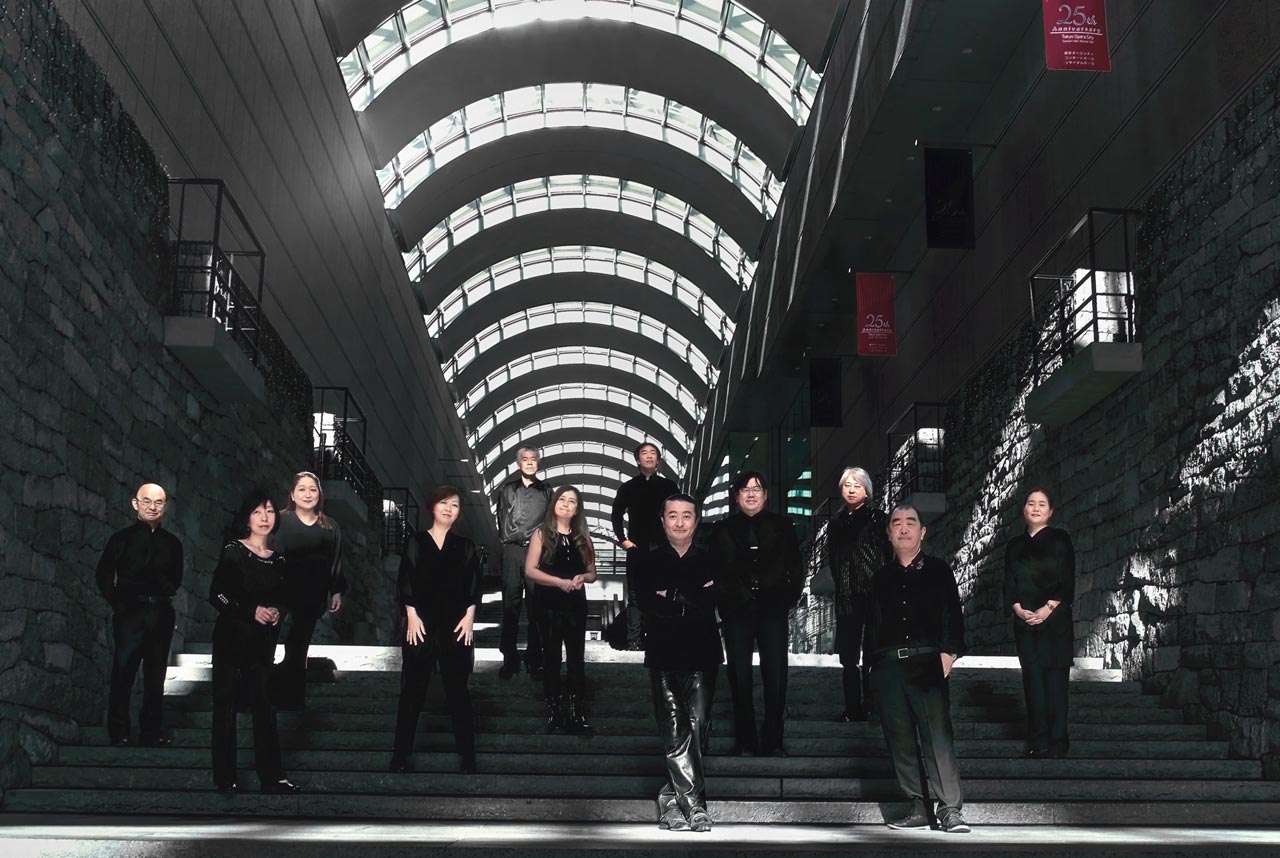 photo by Maki Takagi
Ensemble NOMAD
“True to its name “NOMAD”, they have a complete freedom in the vast repertoire. One of the best and the most radical ensembles in Japan.” – The Stereo Magazine
Formed in 1997, Ensemble NOMAD has been highly acclaimed both nationally and internationally as one of the leading ensembles in the world specializing in the 20th-century and contemporary music. Led by Norio Sato (guitarist/conductor), Ensemble NOMD has brought to life many compositions that are rarely performed but are sure to become 20th-and 21th-century classics. True to its name, Ensemble NOMAD is infinitely flexible and spontaneous in programming the concerts, and the regular concerts, now approaching nearly 90, at Tokyo Opera City have become the "events" that cannot be missed in the contemporary music scene in Japan. For its unique programming and high-quality performance, Ensemble NOMAD was awarded the “KEIZO SAJI Prize” in 2003, and “The Vienna Philharmonic and Suntory Music Aid Award” in 2014 from the Suntory Cultural Foundation.
Ensemble NOMAD’s fields of activity is growing rapidly overseas, starting with the invitation to Amsterdam in autumn 2000 to perform at Gaudeamus Week. Since, the ensemble has made appearances in music festivals in Venezuela, Mexico, France, Belgium, Britain, Korea, China, the Netherlands and Estonia, and future invitations include Finland, Germany, Switzerland and Spain. In recent years, the ensemble has launched its community engagement programmes, in which the ensemble visits schools, nurseries, hospitals and care homes to share the joy of music with those who have limited access to concerts and concert venues.
Ensemble NOMAD has released 23 CDs, of works by such leading Japanese composers as Jo Kondo, Hidemi Ishida, Norio Fukushi and Shinichiro Ikebe. Dai Fujikura’s CDs “Turtle Totem”, “Diamond Dust” “Glorious Clouds” include live recordings. Oversea releases include “Bestiario”, and “Pruebas de vida”, 2 CDs of chamber compositions by a Mexican composer Hebert Vazquez. The original album “Meguru” with a selection of original arrangements was released in May 2014. The 4 CDs of “Contemporary Chinese Composers” series released in 2015 were selected for the “Recommended Listening” by Asahi Newspaper, and for the “Recommended Albums” by Record Geijutsu Music Magazine.
SATO Norio (Conductor/Guitar)
KINOWAKI Dogen (Flute)
KIKUCHI Hideo (Clarinet)
HANADA Wakako (Violin)
KAI Fumiko (Viola)
SATO Yoji (Double Bass)
KATO Kuniko (Percussion)
INAGAKI Satoshi (Piano)
Members in this performance

KIKUCHI Kanae (2nd flute)

HAYASHI Norihide (1st Oboe)
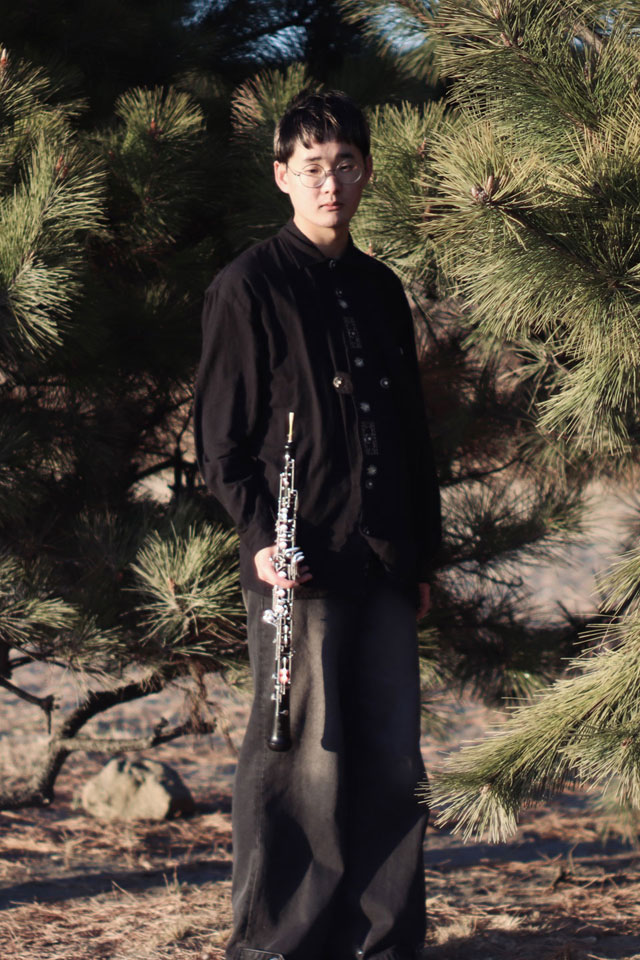
KAMIJO Haruto (2nd Oboe)

UCHIYAMA Chimari (2nd Clarinet)

ARAKI Yuko (2nd Violin)

UNNO Norio (Cello)

HOSONO Ko’ichi (Percussion)

TOZAKI Karin (Percussion)

OTAKI Takuya (2nd Piano)
Staff & Organizer
- Stage Manager
- YAMANUKI Rie
- Sound Designer
- KATAGIRI Takenori
- Video Projection
- ARAI Mayu, NISHIMURA Yuuki Nishimura, HIRAYA Takahiro
- Lighting
- SUGIYAMA Chihiro
- Technical Advisor
- Corinna BELZ
- Graphic Design
- ABE Kota
- Produced by
- No Centre General Incorporated Association
- In cooperation with
- MINOGUCHI Kazumi
- Organized by
- No Centre General Incorporated Association
Presented through the generous support of No Centre membership.